On the Cornish cliffs
I was with my brother on the Cornish cliffs. We were chatting, making jokes, but mostly we were just walking and watching the sea and stone crash against each other. The gulls were wheeling in the precipice, right next to us, arm’s reach away.
It was a grotty, blustery day and my Mum and Dad were far behind us – I could make out their brightly coloured coats as they made their way along the path. They looked tiny – like jelly babies.
It was one of those moments where everything connected – the bluster of the wind, the scary sea, how small my parents seemed out there, and the birds. Maybe if I’d have been on my own, I would have said nothing. But I had an audience. I turned to my brother and I started to tell him Lily’s story.
As soon as I’d finished, two marvellous things happened. First, we all went for a cream tea (yum). Then, I made a decision: I was going to write Lily’s story down. I was going to make it into a book.
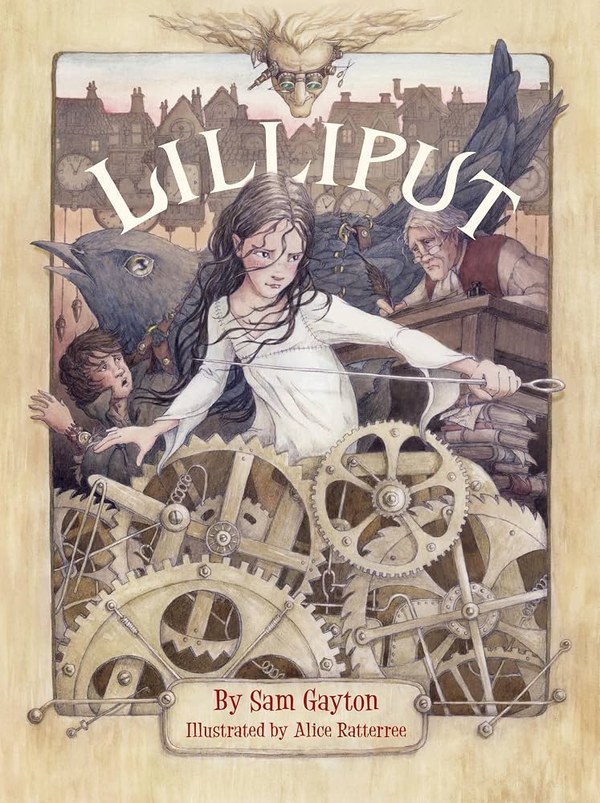
But I felt bad. Guilty. Lily’s story was full of someone else’s ideas – his name was Jonathan Swift, and he wrote a book about the tiny island of Lilliput and the people who lived there. He called the book Gulliver’s Travels.
Could I write a story about a Lilliputian too?
Wasn’t that stealing? Or copyright infringement? Or plagiarism?
It wasn’t like I could ask Jonathan Swift for his permission, either. He died in 1745. Darn. It looked like I was 267 years too late.
Suddenly, my cream tea didn’t taste so creamy.
Thank goodness for Mum, is all I can say.
‘Miffs fin rer fubric fromay,’ she cried out to me, halfway through munching a scone.
No one understood her at all. We wiped the scone crumbs from our eyes and waited for her to chew a bit more.
‘Gulliver’s Travels is in the PUBLIC DOMAIN,’ Mum said at last. ‘That means, because it is so old, it belongs to everyone.’
I stared at her. She was right. Gulliver’s Travels belongs to the public. That means me, you, him, her, the Queen’s butler…
In short: EVERYONE!
Which meant I could DEFINITELY give myself permission to write a sequel to a book I hadn’t written in the first place.
And so I have.
In fact, as I began to research Gulliver’s Travels, I discovered that I was being even LESS original than I thought. When it was published in October 1726, Gulliver’s Travels was about as original as you can get. It was a book of ‘firsts’. It featured:
- the first ever ‘computer’ (which Swift calls ‘The Engine’.)
- the first ever bespectacled hero (take THAT, Harry Potter!)
- the first ever mention of aerial bombardment
As well as plenty of other cool stuff. Everyone loved it. But people weren’t happy with just a first helping. They wanted seconds, too. In fact, as soon as Gulliver’s Travels was published, people began to carry on his story. The book inspired spin-offs, sequels, poems, pamphlets and films. It still does. Gulliver’s Travels is also the first story in English literature to inspire what we now call ‘fanfiction’ – a story inspired by someone else’s story.
Writers wrote hundreds – literally HUNDREDS – more adventures, all set in Gulliver’s world. These stories have a collective name – ‘Gulliverania’.
Hmm, I thought. If all those famous, important, brilliant writers can do it, why can’t I?
So I have.
You should, too. Gulliver’s Travels are like a wonderful collection of old keys. Once you’ve got hold of them, they’ll start opening doors in your head that have never been opened before. You’ll find places where islands float in the air, horses talk, and scientists try to extract sunbeams from cucumbers. Weird places, wild places, funny places. Places full of stories. Places everyone should visit.
So go on. Follow Gulliver. Get travelling. And if you do visit anywhere interesting, I’d love to hear from you…
Send me a message ▶

